Sahayak Academic Repository

Probability and Statistics

CSESemester 3Course Code: MA301

Difficulty

hard

Time Investment

medium

Scoring Potential

moderate

Primary Type

numerical

General Overview

It’s maths time. Probability and Statistics is not going to be a headache during preparation (it might definitely be during the paper). Usually, you are aware of the sections from which the paper will come.
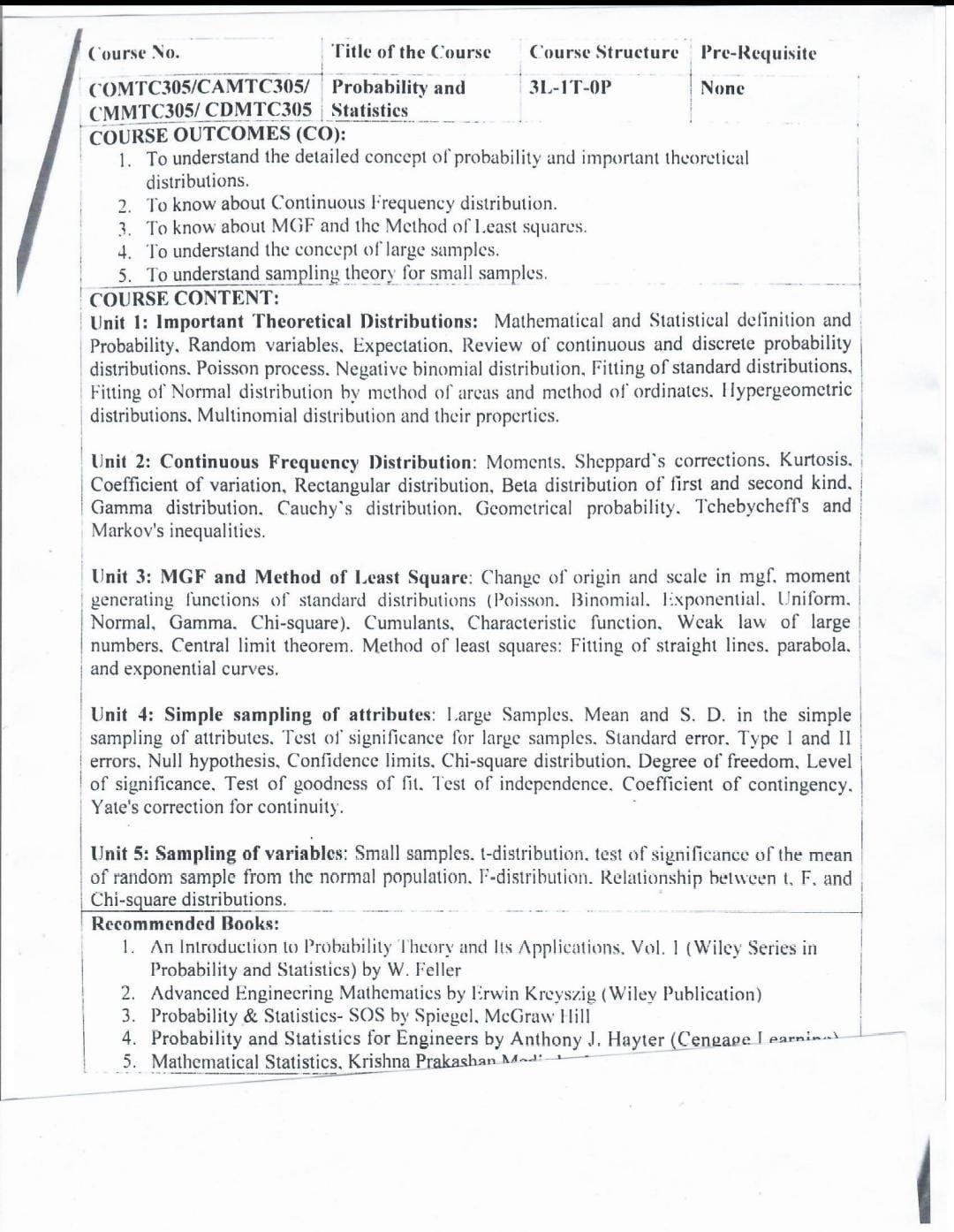
Course Curriculum
01

Important Theoretical Distributions

easyhigh Scoring
  • Introduction – Understand uses of conditional probability and set theory in probability.

  • Distributions – Remember their functions, mean, and variance. They may ask you to derive mean and variance, especially of the Hypergeometric distribution.

  • Fitting – Almost certain to be asked. Binomial fitting is most probable, but Area fitting can also appear.

  • Cover all distributions and fitting properly. Make sure you know how to use your calculator (powers, combinations, etc.), or you won’t be able to solve fitting questions efficiently.

  • Avoid going too deep into Poisson process unless explicitly mentioned in the syllabus.
02

Continuous Frequency Distribution

moderatemedium Scoring
  • Moments – Moments and Kurtosis are almost guaranteed in the paper. Practice thoroughly.

  • Distributions – Practice mean and variance derivations for new continuous distributions — these are popular exam questions.

  • Sheppard’s Correction – Direct formula. Remember it — can be a quick scoring question.

  • Inequalities (Chebyshev’s) – Paper questions can be tricky. Check PYQs for clarity.

  • This unit is tiring but scoring, especially in mid-sem since multiple questions can come from here.

03

MGF and Method of Least Squares

hardmedium Scoring
  • MGF (Moment Generating Function) – Check notes and practice derivations. Same for cumulants.

  • CLT (Central Limit Theorem) – Learn to identify what type of question it is; otherwise, you may get confused about what to apply. This section is important and requires proper question exposure.

  • Fitting of Line (Least Squares) – Easiest part of the unit and almost guaranteed in exams. Do it properly.

  • Don’t take this unit lightly — it can get messy. If facing serious difficulty, at least prepare: MGF derivation, Fitting of line.

  • But ideally, practice CLT questions properly — without exposure, it’s easy to make mistakes in the exam.

04

Simple Sampling of Attributes

moderatehigh Scoring
  • Introduction – Understand difference between sample and population, Type I and Type II errors, and other basic concepts.

  • Tests – Chi-square test and Test of Independence are almost certain to be asked.

  • Yates’ Correction – Remember the formula and when to apply it.

  • Go through the full playlist/notes in order. Don’t rush-watch everything at once — the topics are connected, and you might get confused about which test to apply where.

05

Sampling of Variables

easyhigh Scoring
  • Tests – Do every test mentioned in the syllabus (t-test, F-test, etc.). Also prepare theoretical points (mean, variance assumptions, conditions of applicability), as theory questions can appear here.

  • Relations Between Tests – Slightly confusing. If low on time, you may skip deep derivations but at least understand basic connections.

  • It’s a small unit. Prepare the tests properly. If low on time, at least memorize the relationships and conditions of application.

Examination Discourse

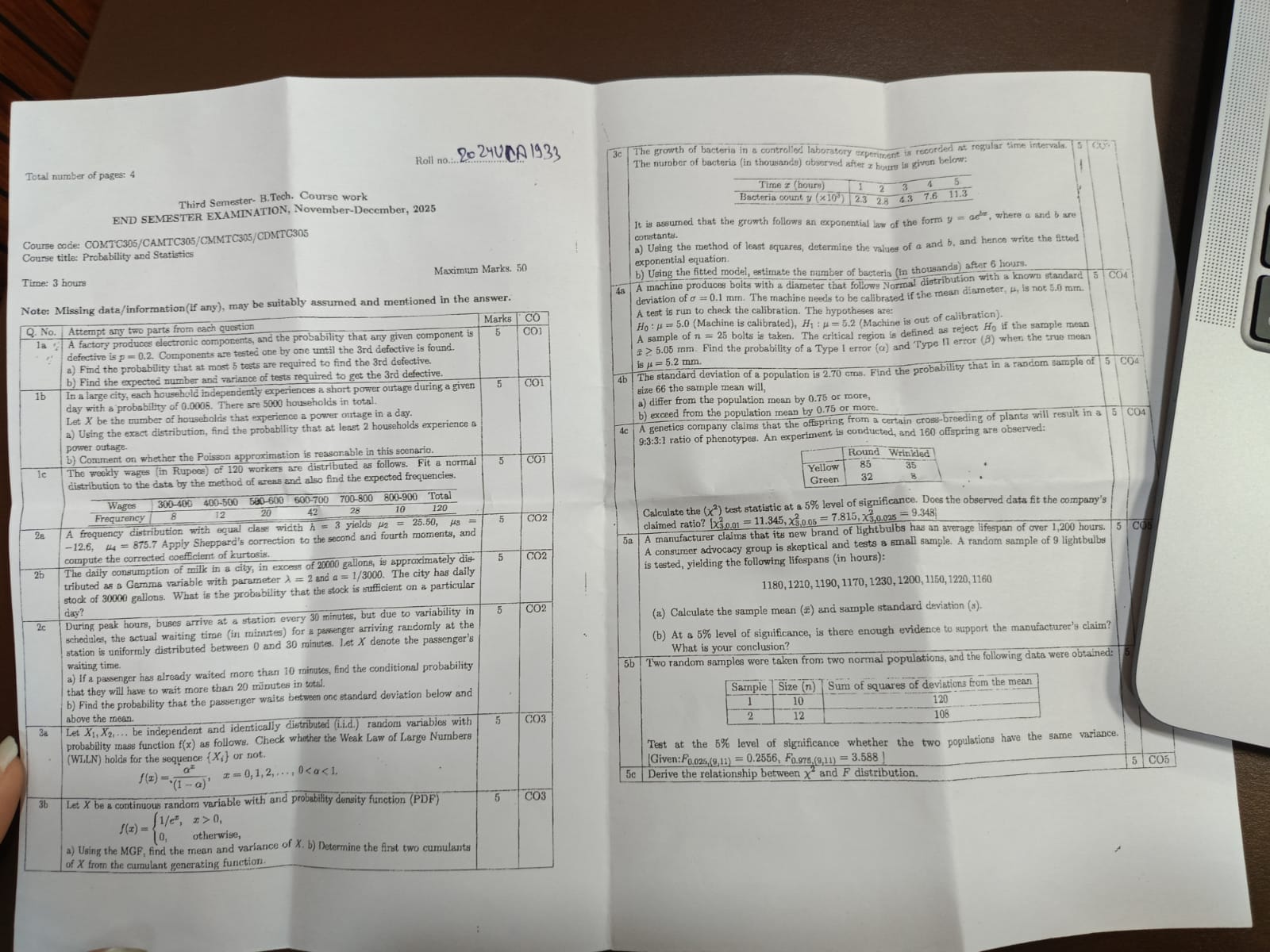
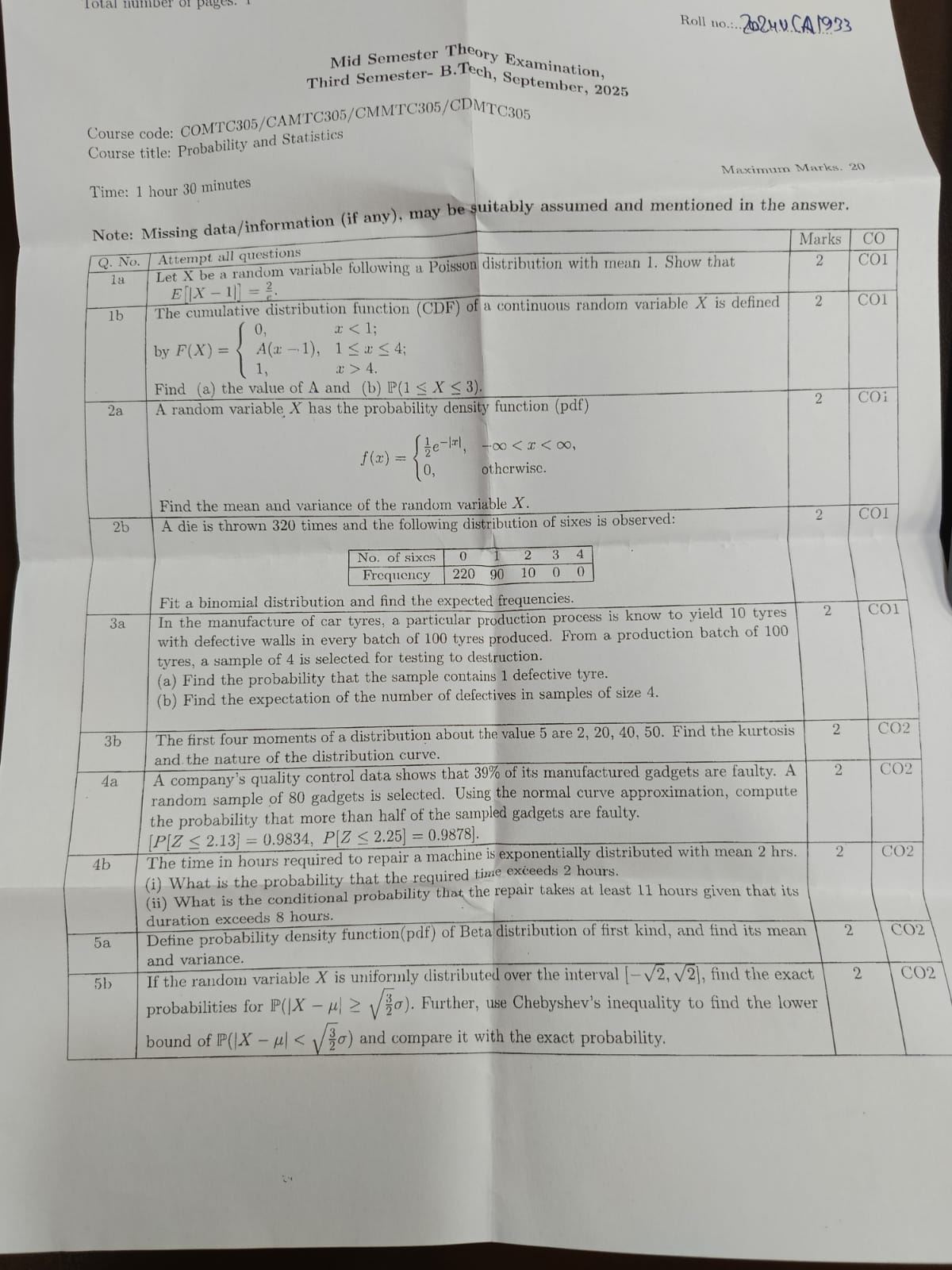
§ Mid-Semester Thesis

Focus on:

  • Fitting of distributions
  • Beta distribution
  • Chebyshev’s inequality
  • Moments

§ End-Semester Thesis

Most important topics:

  • Moments
  • Fitting of distributions
  • MGF
  • Fitting of line (Least Squares)
  • Chi-square test
  • Test of independence
  • t and F distributions

Previous Year Questions

Curated by Aryan Anand