Sahayak Academic Repository

Operating System

CSESemester 3Course Code: CACSC301

Difficulty

moderate

Time Investment

medium

Scoring Potential

high

Primary Type

mixed

General Overview

It’s a core subject, and you’ll probably end up liking it since it’s very logical. It’s especially important because it’s asked both in university exams and in interviews, so it’s better to study it properly.
Course Curriculum
01

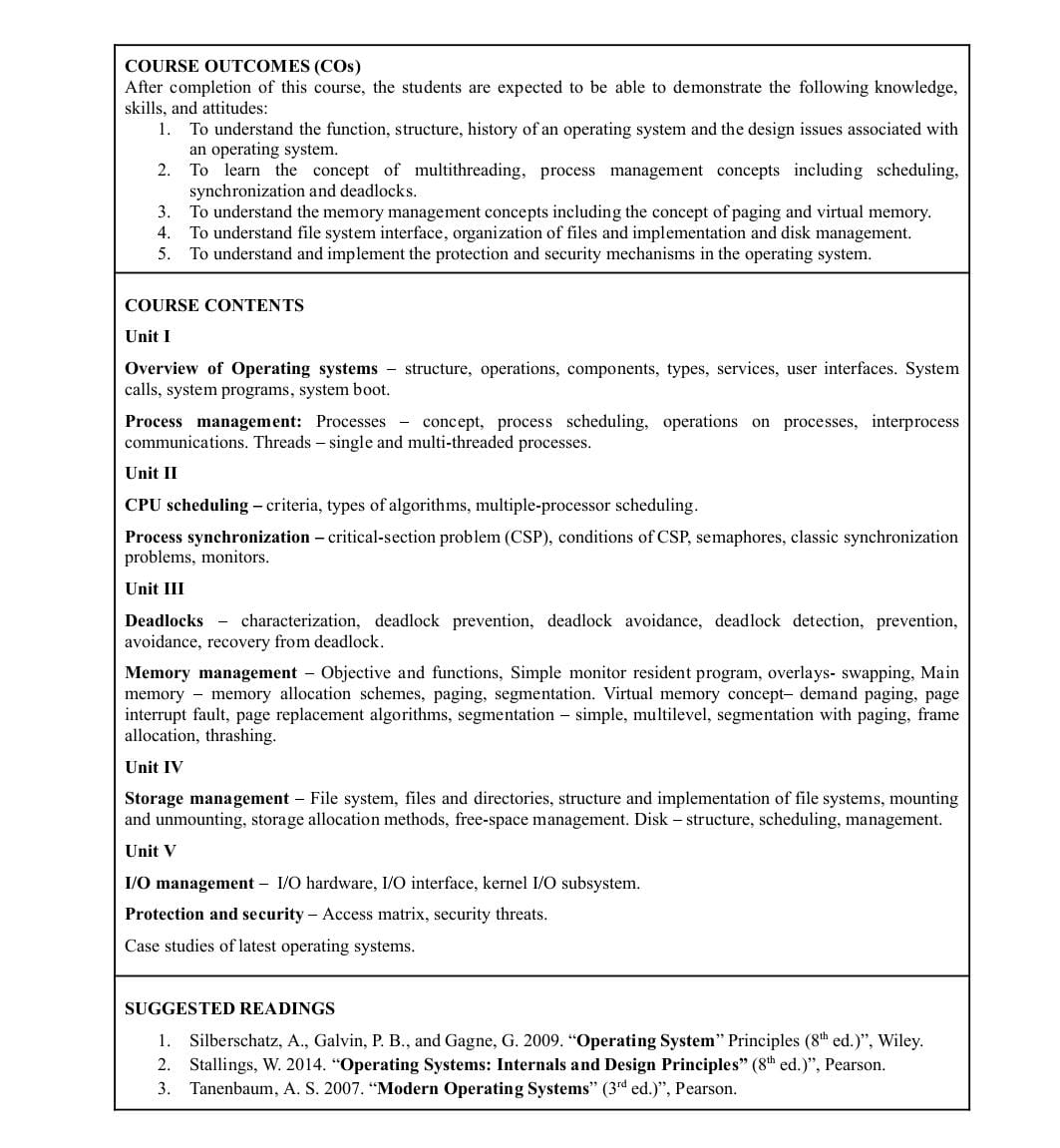
Overview and Process

easyhigh Scoring
  • OS Overview – Memorize different types of OS, architecture of OS, user interface, and system calls.

  • Process – Understand what a process is, the difference between a process and a thread, and real-life examples of multithreaded processes.

  • CS Knowledge Hub has good videos on fork-related questions. If you have time, go through them.

  • Properly prepare the theory, and you’ll score well here. The only somewhat complex question asked is usually related to fork(). That too can be mastered by understanding it from Gate Smashers and then solving questions from the channel mentioned above.

  • Also, revise: User mode vs Kernel mode, Basic Linux commands.
02

Scheduling and Synchronization

moderatehigh Scoring
  • Scheduling – All scheduling algorithms are important, especially Round Robin. Practice each one properly.

  • Multilevel Queue Scheduling has a high chance of being asked, so prepare theory and diagrams for it.

  • Synchronization – Mostly theory. Cover: Critical Section Problem (CSP), Producer-Consumer Problem, Dining Philosophers Problem, Printer Spooler. They may ask you to explain code, so understand it properly.

  • Prepare working and diagrams of synchronization methods: Semaphore, Monitor (with diagram), Locks, Peterson’s Solution (software-based).

  • Prepare scheduling very well — it has very high ROI. Questions from the synchronization part are a bit uncertain. They may ask you to explain a synchronization problem or a solving method. It’s better to prepare everything so you can fill pages for almost any question.

03

Deadlock and Memory Management

hardmedium Scoring
  • Deadlock – Almost certain that there will be a question from Banker’s Algorithm.

  • RAG (Resource Allocation Graph) is also important — practice both.

  • Memory Management – Very heavy and packed with concepts.

  • Memory allocation algorithms are commonly asked.

  • Paging questions are also common (avoid weak explanations; refer to better resources like 5 Minutes Engineering).

  • Practice page replacement algorithms.

  • There is a formula-based question related to cache hit ratio — practice that properly.

  • If short on time, at least cover: Page replacement algorithms, Banker’s Algorithm. Avoid detailed paging derivations only if you are extremely low on time — otherwise, try to understand it properly.

04

Storage Management

easyhigh Scoring
  • Disk – Cover seek time and disk structure (track, sector, cylinder, etc.).

  • Disk scheduling is almost certain, especially: C-LOOK, C-SCAN.

  • File Allocation – Theory (prepare from good notes or tutorials).

  • RAID – Study RAID levels up to RAID 5.

  • Practice disk scheduling properly and make sure to write correct units (like cylinders).

05

I/O and Security

easyhigh Scoring
  • Security – Access Matrix is very important. Study its implementation methods as well.

  • Also prepare common security threats and their prevention methods.

  • This is a somewhat unpredictable unit as the content is limited. Confirm with your teacher. Sometimes they may ask File Allocation methods here instead of Unit 4.

Examination Discourse

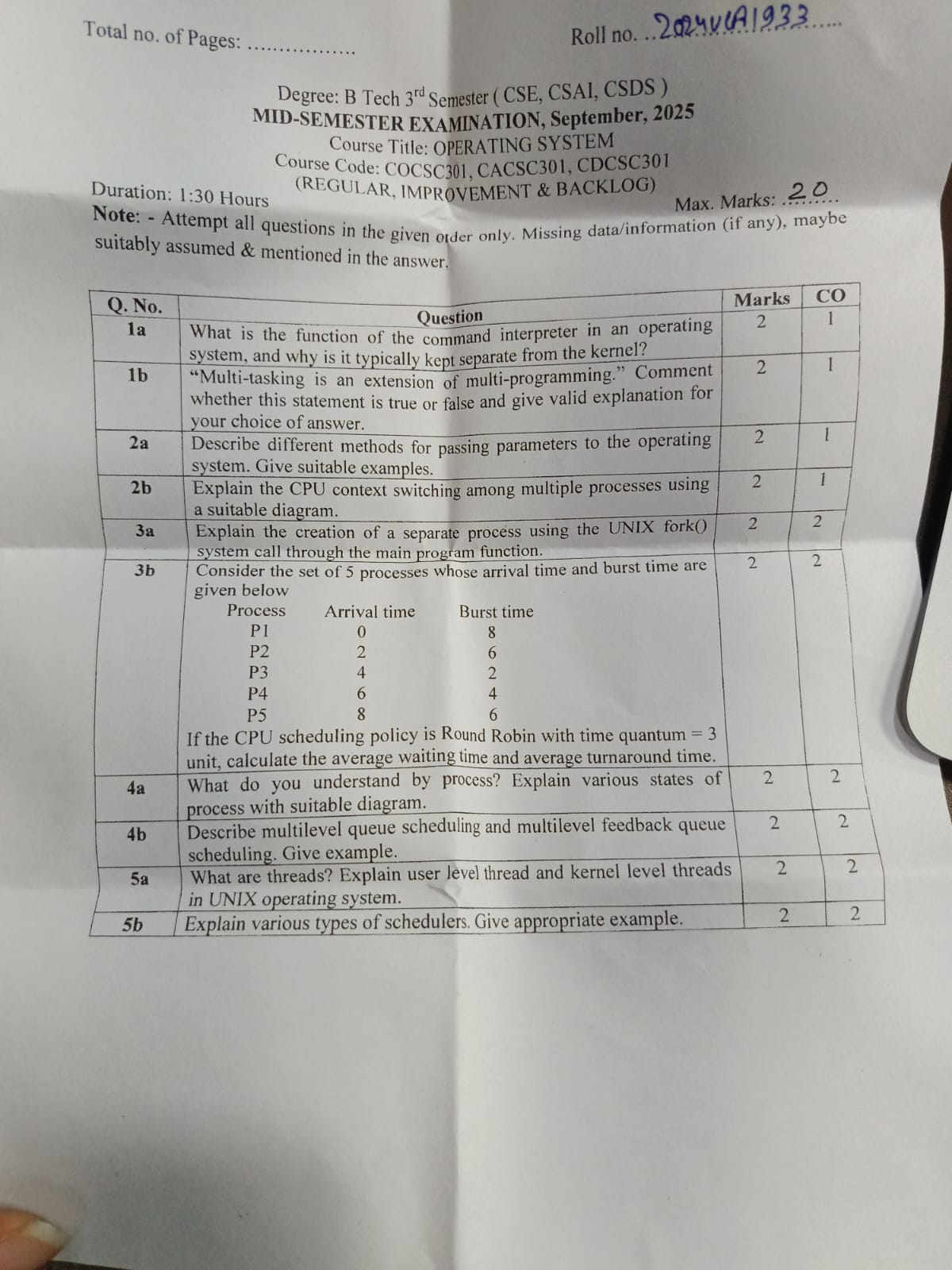
§ Mid-Semester Thesis

Focus on:

  • Theory from PPT
  • Types of OS
  • Multiprogramming and Multitasking
  • Threads and Processes
  • CPU Scheduling
  • User Mode vs Kernel Mode

§ End-Semester Thesis

Most important topics:

  • fork()
  • Threads
  • CPU Scheduling
  • Banker’s Algorithm
  • Disk Scheduling
  • Page Replacement
  • Access Matrix
  • File Allocation
  • Segmentation vs Paging

Previous Year Questions

Curated by Aryan Anand