Sahayak Academic Repository

Database Management System

CSESemester 3Course Code: CACS0302

Difficulty

moderate

Time Investment

medium

Scoring Potential

high

Primary Type

theory

General Overview

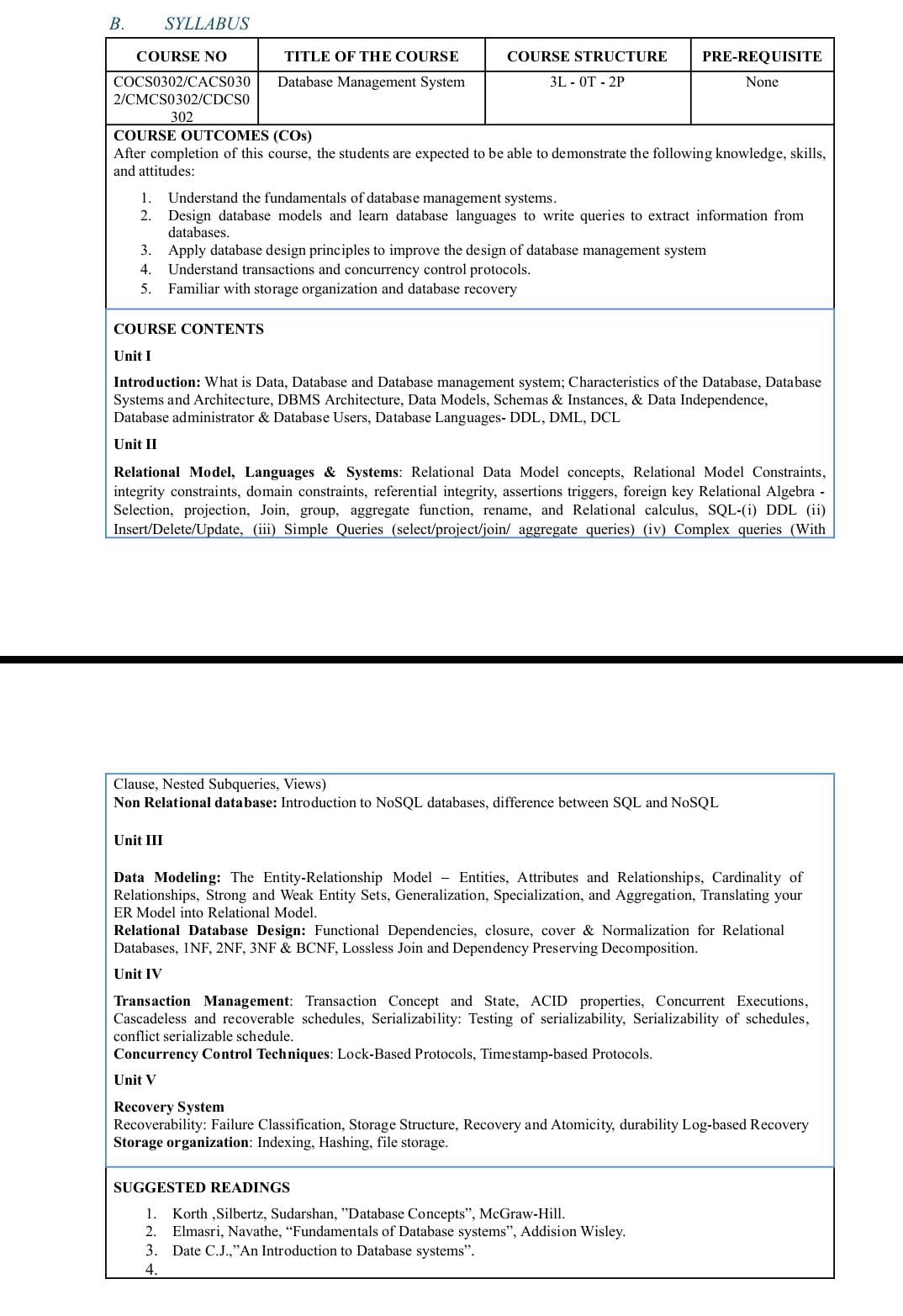
This is one of your first core subjects in your branch. It won’t just be required for exams but will stay with you throughout your career. It’s asked in interviews too.
Course Curriculum
01

Introduction

easyhigh Scoring
  • Overview: This is the easiest one of the bunch. Basics of databases. It’s filled with definitions. Notes + GPT are the best resources for this one.

  • Overview of Data: Refer notes + GPT

  • Important Topics: DBMS architecture, DBMS users and their roles, Different segments of DB (DML, DQL, etc.), Data independence

  • Atomicity: What is atomicity (very important)

  • End Advice: Since this is completely theory-based, don’t skip any keyword from the syllabus. Write a lot — they like filled pages.
02

Relational Model, Languages & Systems

moderatemedium Scoring
  • Overview: This is where things pick up. This unit requires query writing. You’ll learn queries in lab (I mean practice — actual learning will only happen in your room).

  • Relational Database: Best resource: Knowledge Gate channel’s playlist. Be well-versed in joins. Triggers are rare but can be asked in viva. Relational Algebra is very important. Relational Calculus is written in the syllabus but is rarely asked.

  • Queries: Must practice PYQs for query writing.

  • End Advice: Query writing should be practiced properly; otherwise, you won’t get it right in the final paper. Learn the difference between relational and non-relational databases with real examples. Different types of joins and constraints are important — they are frequently asked in exams. Keys (more in Unit 4) are very, very important.

03

Data Modelling and Design

hardmedium Scoring
  • Overview: This is the toughest unit of this subject. One part focuses on ER diagrams, which is manageable. But the second part can be very tough without decent practice.

  • Modelling: Must know ER diagram to relational model conversion rules. Refer Luv Babbar or Giraffe Academy. This is a confirmed topic for both midsems and endsems. Definitions of generalization and specialization are important.

  • Database Design: Tough topic. Refer Knowledge Gate. Requires decent practice. If low on time, you can skip this. You’ll have to find forms, find keys, and understand advantages of each normalization level.

  • End Advice: This is a jam-packed unit. If low on time, just cover ER diagrams and normalization rules. Skip the key-finding part if extremely short on time.

04

Transactions and Concurrency

moderatemedium Scoring
  • Overview: Very theoretical topic. A bit relaxing compared to the last two jam-packed units, but still not very light. Theory will make it seem easy, but check PYQs as some questions can be tricky.

  • Transactions: Must know all terms mentioned in the syllabus. Not very deep, but you should be able to define and explain them. Refer Knowledge Gate.

  • Serializability: Tricky topic. Must know graph method to check serializability. Refer PYQs and Knowledge Gate.

  • Concurrency: Straightforward questions. Explain lock methods with diagrams.

  • End Advice: This is a scoring unit. Don’t mess it up. Focus especially on ACID properties with examples and locking mechanisms.

05

Recovery System & Storage

easymedium Scoring
  • Overview: The last unit is pretty easy. Mostly definitions and diagrams. (Note: Indexing and hashing are mentioned, but they’re mostly asked in OS, so you’ll already be somewhat familiar.)

  • Recovery System: Immediate and deferred recovery (refer Gate Smashers). Shadow paging (easy). Log-based recovery (important).

  • Storage Organization: Not asked much. You can use ChatGPT and gather basic information.

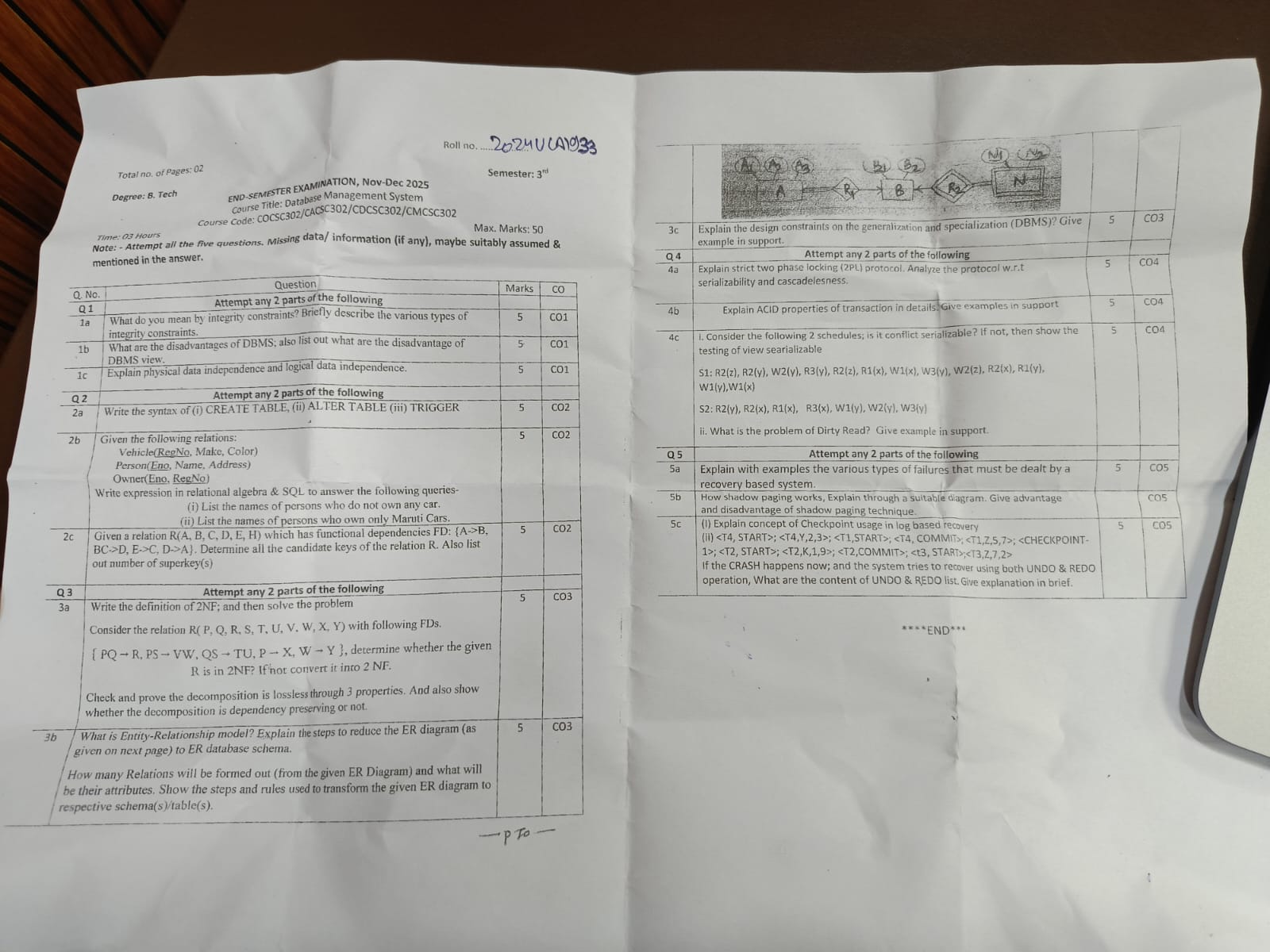
  • End Advice: Fairly simple unit. Mostly they ask log-based recovery examples like: if the system fails at a certain point, what will be in the database? Shadow paging concept with diagram is important.

Examination Discourse

§ Mid-Semester Thesis

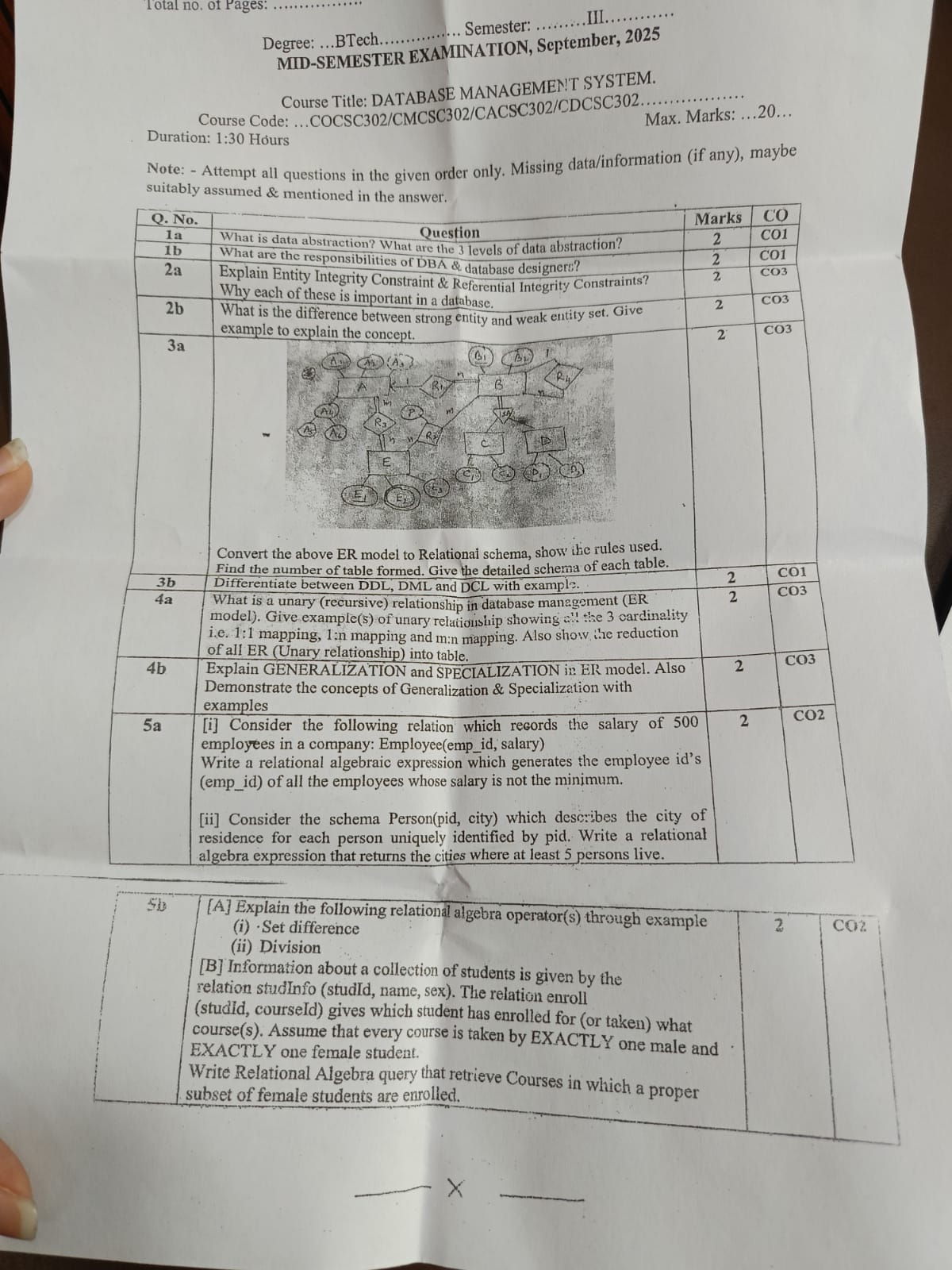
Just cover all basic definitions, ER diagrams, and queries.

§ End-Semester Thesis

If you want over 40, you honestly will have to work a lot, especially in normalization. Practice lots of queries and relational algebra. Write a lot and add diagrams wherever you can.

Previous Year Questions

Curated by Aryan Anand