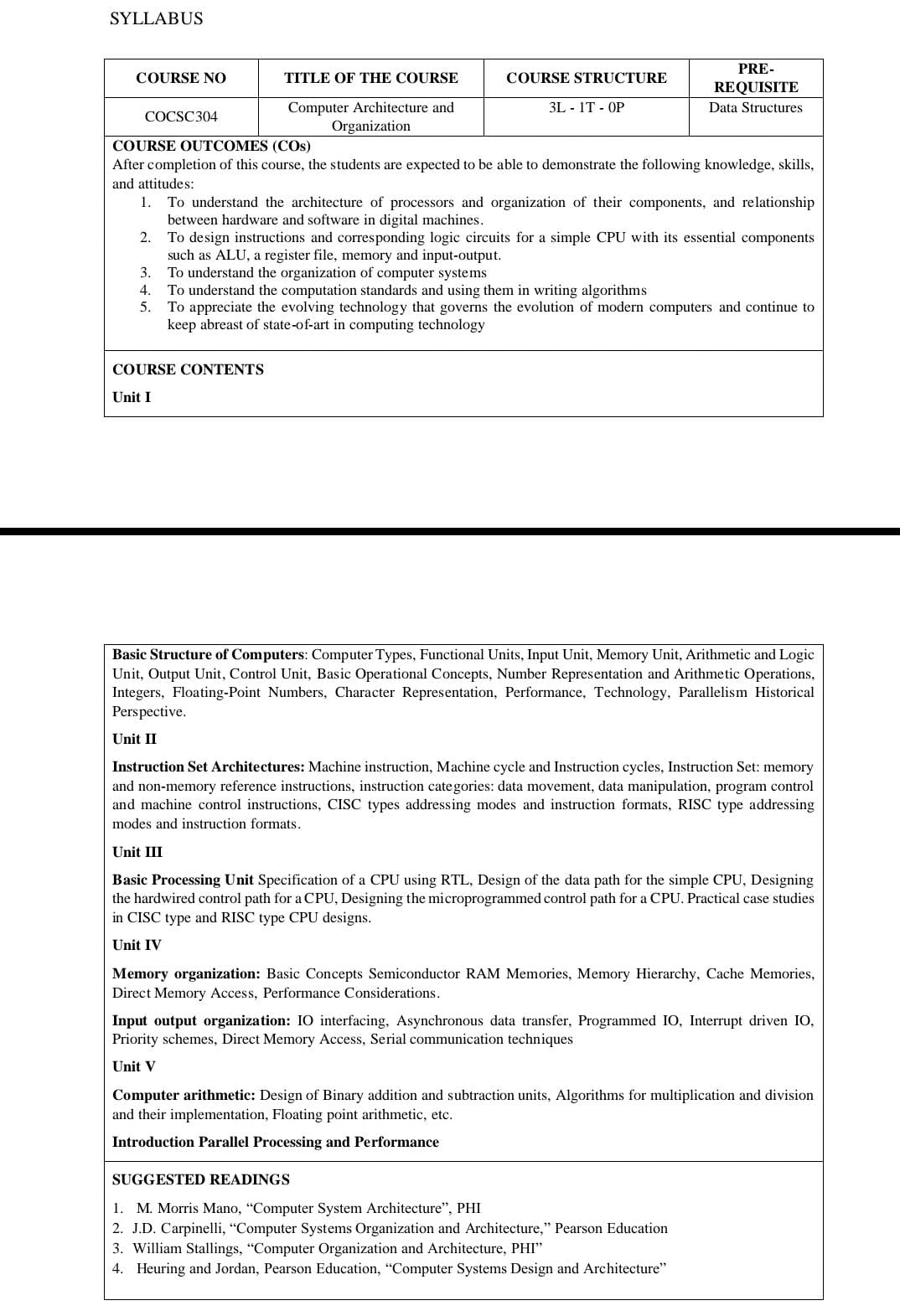
Sahayak Academic Repository

COA (Computer Organization & Architecture)

CSESemester 3Course Code: CS305

Difficulty

moderate

Time Investment

high

Scoring Potential

high

Primary Type

theory

General Overview

Alright, this is probably one of the most misunderstood subjects. People think it will be tough like DLD or core ECE subjects, but honestly, it’s not (only the designing questions may feel slightly difficult, and that too is usually just 1–2 questions).
Course Curriculum
01

Basic Structure of Computers

easyhigh Scoring
  • Basic Data Transfer – Understand RTL, bus structure, and tri-state buffer. Diagrams are very important — practice them.

  • Operations – Understand basic operations and their circuit implementation, especially arithmetic circuits. Shift micro-operations are also important.

  • Just properly cover bus structure, tri-state buffer, arithmetic circuits, and shift operations. It’s simple but conceptual.
02

Instruction Set Architecture

moderatemedium Scoring
  • Registers – Understand what registers are, why they are used, and the bus-register diagram.

  • Instructions – The most important aspect of this subject. You don’t have to memorize all instructions; just understand common ones and how they function.

  • CISC vs RISC – Very important. Prepare a proper difference table. Also go through overlapped register window architecture.

  • Addressing Modes – Extremely important. Prepare with examples. Almost certain to be asked.

  • Instruction Format – Very important.

  • If short on time, prepare: Roles of registers, Bus-register diagram, RISC vs CISC difference. But addressing modes and instruction formats are unskippable — they may also appear in other units.

03

Basic Processing Unit

moderatemedium Scoring
  • Control Unit (CU) – Difference between Hardwired and Microprogrammed CU is the most important.

  • A circuit example is also important to understand.

  • They may ask designing questions from here (skip only if very low on time).

  • Refer to Morris Mano for this. If extremely short on time, prepare the difference table and skip detailed designing questions.

04

Memory and I/O

easyhigh Scoring
  • Memory – Memory hierarchy (diagram is important). DMA (full concept with diagram). Performance formula — memorize it.

  • I/O – Every keyword in the syllabus can be a question. Interrupt-driven I/O, Handshaking, DMA transfer. All are important.

  • Go through Morris Mano and practice all diagrams properly.

05

Computer Arithmetic

moderatehigh Scoring
  • Algorithms – Do all arithmetic algorithms (confirm with your teacher if division is in the syllabus). Practice their flowcharts. Don’t memorize flowcharts — if you understand the algorithm, you can derive them.

  • Pipelining – Important concept that reappears in MPMC. Even if not asked in great depth, cover: Meaning, Working, Hazards/issues, Prevention techniques.

  • If very low on time, at least cover Booth’s Algorithm properly.

Examination Discourse

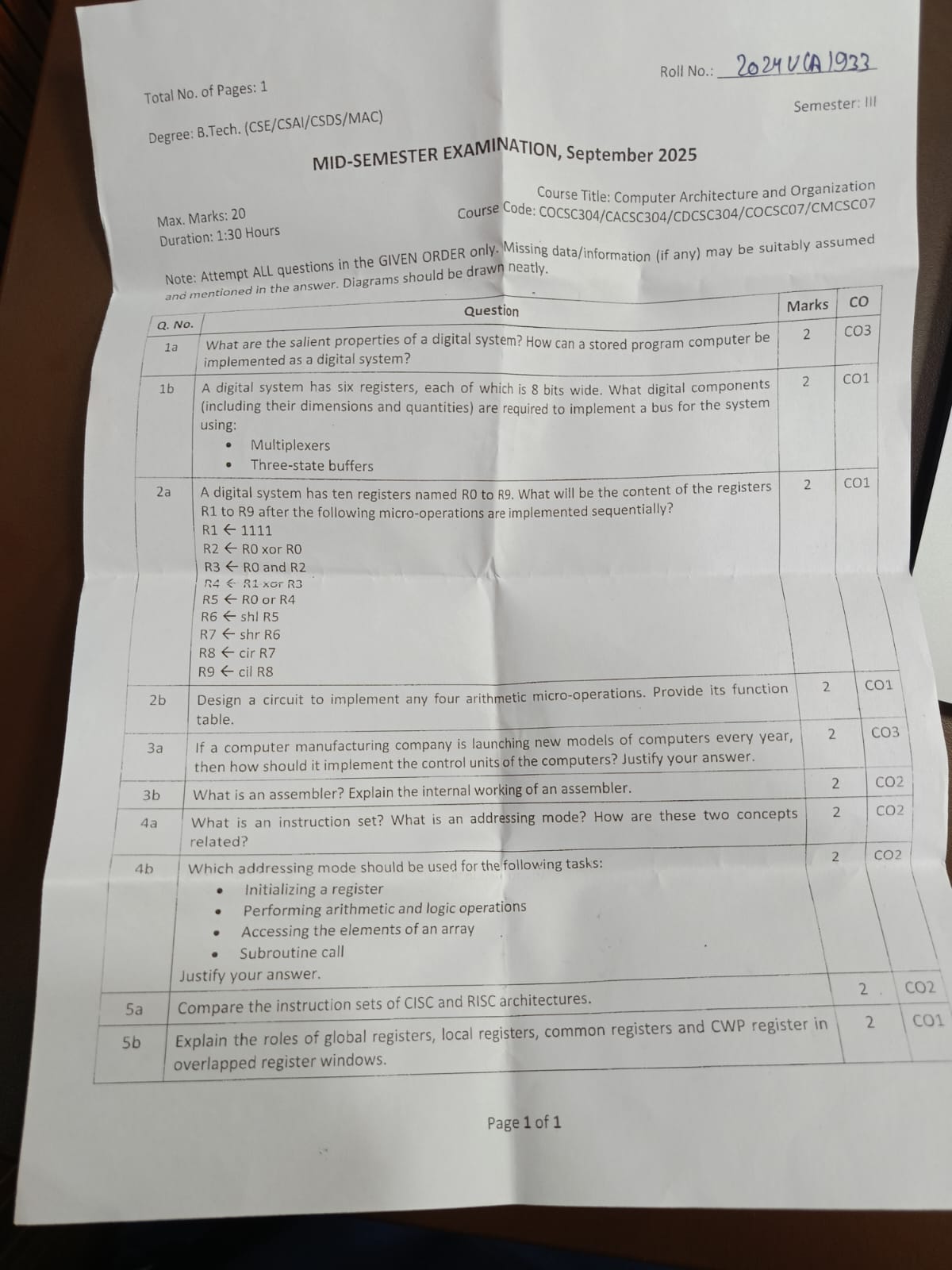
§ Mid-Semester Thesis

Focus on:

  • Addressing modes
  • Instruction format
  • Bus diagram
  • Tri-state buffer
  • RISC vs CISC
  • Arithmetic and shift operations
  • First pass and second pass assembler (skip only if extremely low on time)

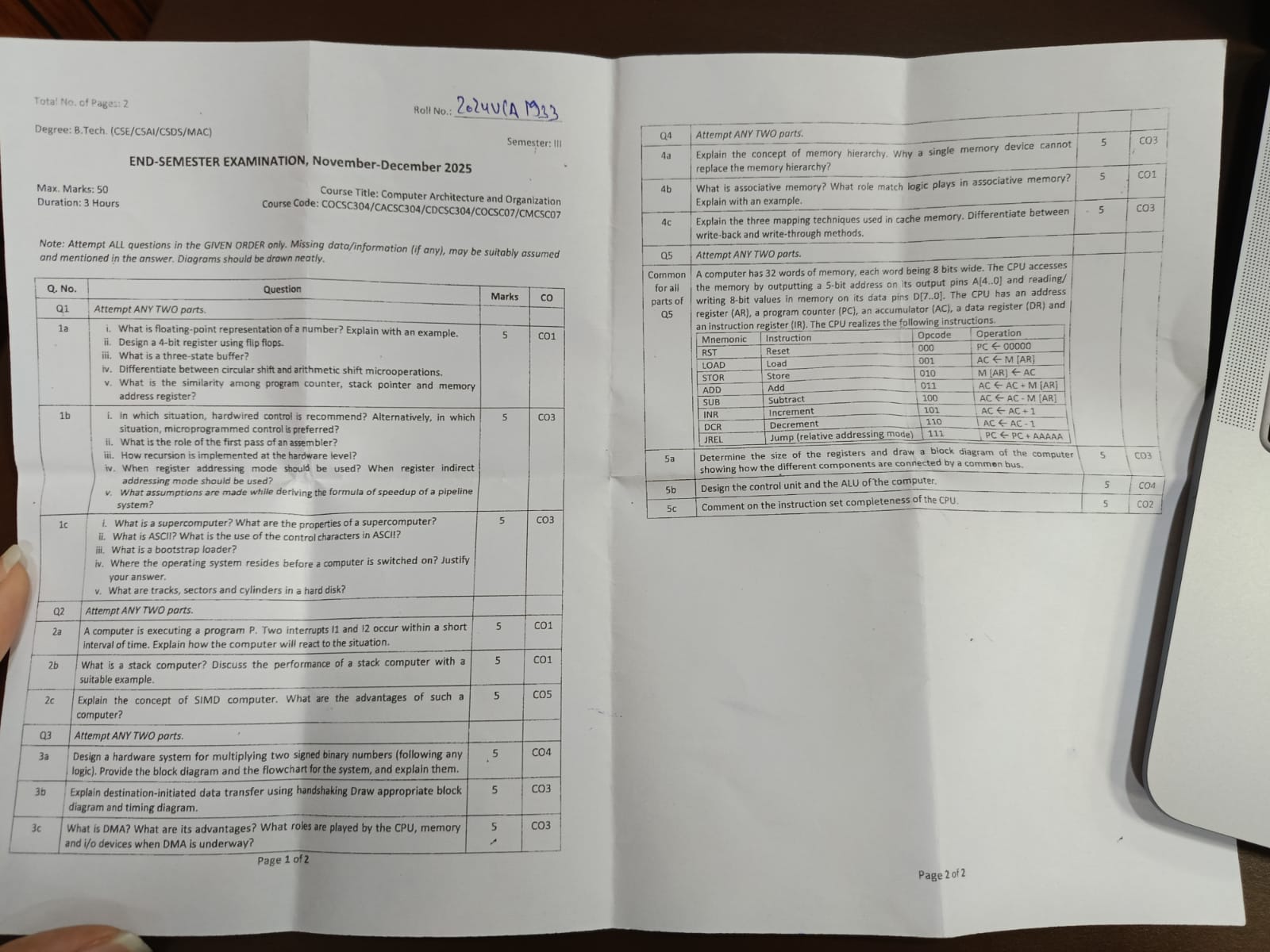
§ End-Semester Thesis

Most important topics:

  • Hardwired vs Microprogrammed Control Unit
  • Booth’s Algorithm
  • DMA
  • Memory Hierarchy
  • Addressing Modes
  • Instruction Format

Previous Year Questions

Curated by Aryan Anand